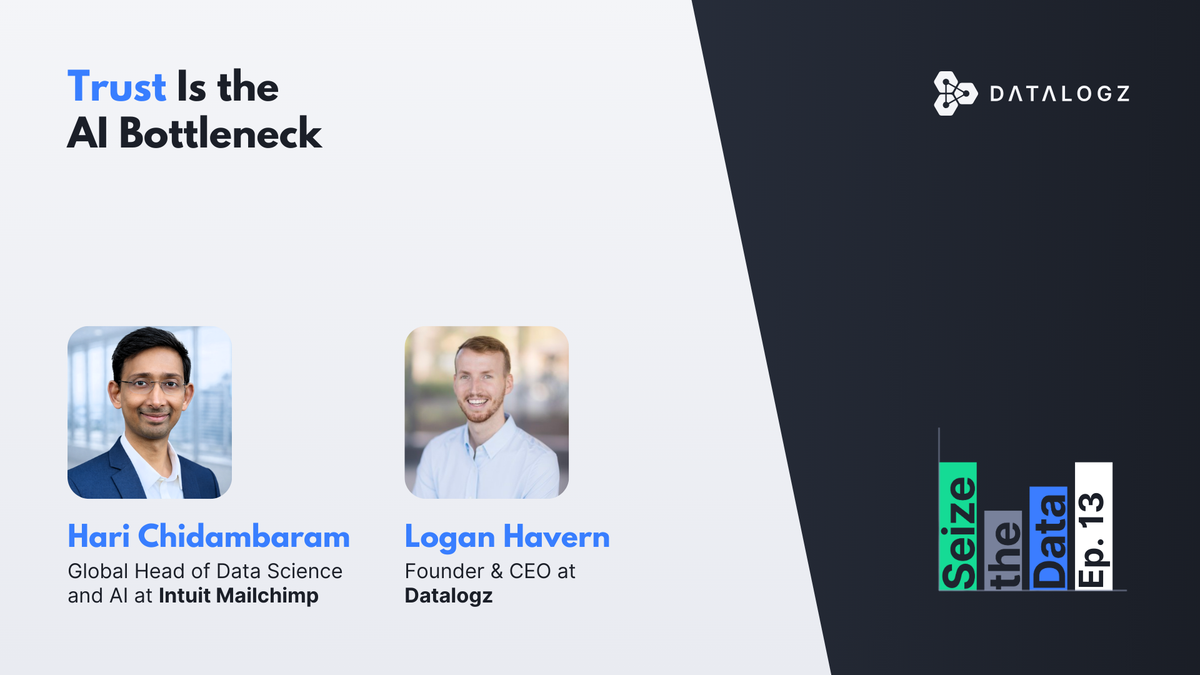
Seize the Data #13 - Trust Is the AI Bottleneck with Hari Chidambaram
The conversation closes on a risk most teams are already feeling: the “curse of plenty,” where BI sprawl and semantic drift grow faster than organizations can maintain trust.
What does it really take to operationalize enterprise AI, beyond the demos?
Hari Chidambaram is a senior data and AI leader who has built decision-driven data and AI platforms at Amazon Pay and Intuit Mailchimp. In this Seize the Data conversation, he breaks down why most AI transformation efforts stall when they hit real-world ambiguity - unclear definitions, messy data, and weak ownership. AI does not remove judgment. It puts it under a spotlight.
We also get into the modern foundations that make AI usable inside complex organizations: customer 360 and identity across siloed systems, governed data with semantic clarity, and connected context through knowledge graphs. The conversation closes on a risk most teams are already feeling: the “curse of plenty,” where BI sprawl and semantic drift grow faster than organizations can maintain trust.
Seize the Data is an initiative by Datalogz to host conversations with data leaders to gather and share insights about what's happening and what's to come in the space. Find out more about us here: datalogz.io.
Frequently Asked Questions
Common questions about this topic, answered.
Why do enterprise AI transformation efforts stall after the demo phase?
According to Hari Chidambaram, a senior data and AI leader from Amazon Pay and Intuit Mailchimp, most AI efforts stall when they hit real-world ambiguity—unclear definitions, messy data, and weak ownership. AI doesn't remove the need for human judgment; it puts existing data quality and governance gaps under a spotlight.
What foundational capabilities do organizations need before deploying enterprise AI?
Successful enterprise AI requires three key foundations: customer 360 and identity resolution across siloed systems, governed data with semantic clarity, and connected context through knowledge graphs. Without these, AI tools struggle to deliver reliable, trustworthy outputs in complex organizations.
What is the curse of plenty in BI and analytics environments?
The 'curse of plenty' describes how BI sprawl and semantic drift grow faster than organizations can maintain trust in their data assets. This happens when dashboards, reports, and metrics proliferate without governance, making it increasingly difficult to know which assets are accurate or authoritative. Datalogz addresses this by governing over 720,000 BI assets across enterprise deployments, helping teams identify and eliminate redundant or unreliable content.
How does BI sprawl impact AI readiness in enterprises?
BI sprawl creates conflicting definitions, duplicate metrics, and unclear data ownership—all of which undermine AI systems that depend on consistent, trusted data. Organizations experiencing sprawl often find their AI initiatives bottlenecked by the need to first establish semantic clarity and governance. Datalogz has identified over 1.4 million optimization issues across customer BI environments, many related to governance gaps that would compromise AI initiatives.
Why is trust considered the bottleneck for enterprise AI adoption?
Trust is the bottleneck because AI amplifies existing data problems rather than solving them. When data definitions are ambiguous, ownership is unclear, or semantic drift has occurred across BI assets, AI outputs inherit those inconsistencies. Building trust requires governed data foundations with clear lineage and semantic clarity before AI can deliver reliable business value.