Future Frontiers: Navigating Enterprise Analytics in the AI Era
The gathering aimed to build on Datalogz’s tradition of fostering open dialogue among data experts, drawing attention to the role that AI and data governance play in achieving sustainable transformation.

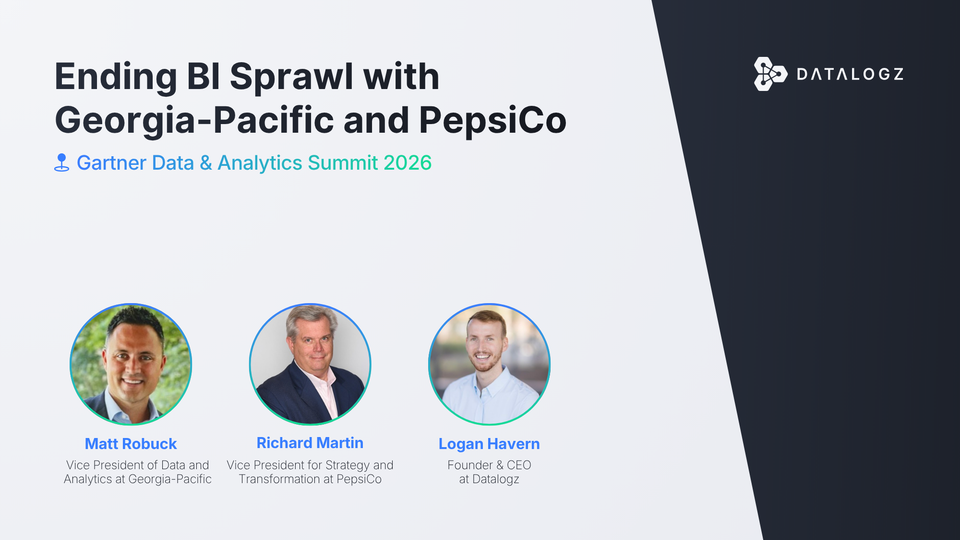
We recently hosted a fireside chat featuring DJ Patil, former Chief Data Scientist for the United States, alongside Kristyn Jones, US Under Secretary of the Air Force - moderated by Logan Havern, CEO of Datalogz.
The gathering aimed to build on Datalogz’s tradition of fostering open dialogue among data experts, drawing attention to the role that AI and data governance play in achieving sustainable transformation.
Learn more about Datalogz here: datalogz.io.
Frequently Asked Questions
Common questions about this topic, answered.
How is AI changing enterprise analytics and data governance?
AI is transforming enterprise analytics by enabling faster insights, automated anomaly detection, and more sophisticated governance workflows. However, sustainable AI transformation requires strong data foundations—organizations need visibility into their BI environments and proper governance frameworks before layering on AI capabilities. Experts like DJ Patil, former U.S. Chief Data Scientist, emphasize that data quality and governance are prerequisites for successful AI adoption.
What do data leaders need to know about AI readiness for analytics?
AI readiness starts with understanding your current analytics landscape—knowing what BI assets exist, who uses them, and whether data is governed properly. Platforms like Datalogz help enterprises achieve this visibility by governing over 720,000 BI assets and identifying more than 1.4 million optimization issues across customer environments. Without this foundation, AI initiatives risk amplifying existing data quality problems.
Who is DJ Patil and what is his perspective on enterprise data strategy?
DJ Patil served as the first U.S. Chief Data Scientist under the Obama administration and is a recognized authority on data-driven transformation. He advocates for treating data as a strategic asset and emphasizes that successful AI adoption requires robust governance, clean data foundations, and cross-functional collaboration between technical and business teams.
How should enterprises prepare their BI environments for AI integration?
Enterprises should audit their existing BI landscape to eliminate sprawl, identify unused or duplicate content, and establish governance standards before integrating AI. Datalogz customers have realized over $50M in quantified value by addressing governance, cost, performance, and security issues across their BI environments—creating the clean foundation AI systems need to deliver accurate insights.
What role does data governance play in sustainable AI transformation?
Data governance ensures AI systems are trained on accurate, well-documented, and properly secured data. Without governance, organizations face risks like biased outputs, compliance violations, and unreliable analytics. Governance alerts alone have surfaced over $16.9M in value for Datalogz customers, demonstrating how foundational governance work directly impacts enterprise outcomes.