Decision Intelligence isn't an AI problem. It's a trust problem.
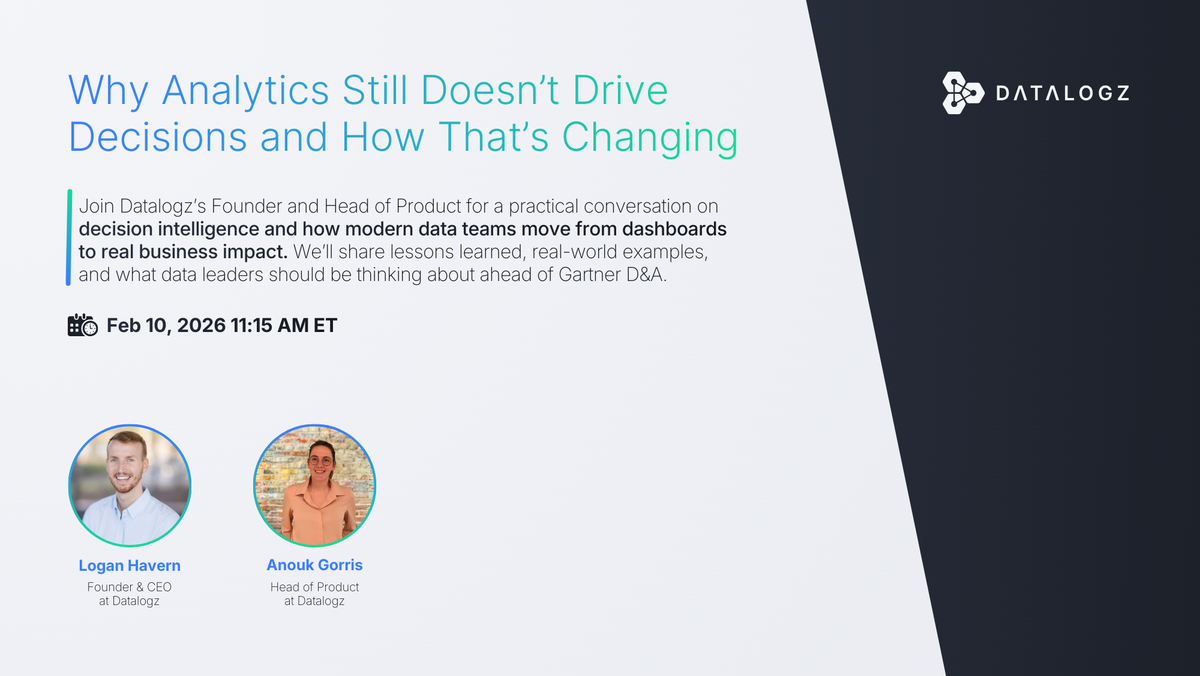
Logan Havern (CEO, Datalogz) and Anouk Gorris (Director of Product, Datalogz) ran a session unpacking what decision intelligence means in practice, why traditional BI patterns are falling short, and what it actually takes to get there.
Enterprises want decisions faster. Real-time insights. Automated workflows. AI that turns analysis into action without a human in the loop for every step.
That ambition is real, and the technology to support it is finally credible. But there is a gap between where most BI environments actually are and what decision intelligence requires, and that gap is widening, not closing.
Earlier this month, Logan Havern (CEO, Datalogz) and Anouk Gorris (Director of Product, Datalogz) ran a session unpacking what decision intelligence means in practice, why traditional BI patterns are falling short, and what it actually takes to get there. Here is what stood out.
Report growth is a symptom, not a success metric
Across Datalogz' customer base, there was an average 77% year-over-year increase in reports and dashboards from 2025 to 2026.
That number does not tell a story of thriving analytics. It tells a story of friction.
When users cannot find an existing asset, cannot tell if it has been validated, cannot identify who owns it, or cannot trust that it is current, creating something new is faster than figuring out whether something old is safe to use. That shortcut feels efficient in the moment. Over time, it compounds. More reports create more ambiguity, which reduces reuse, which drives more creation. The environment grows. Shared confidence does not.
The organizations with the most dashboards are often the ones with the least clarity about which ones to actually act on.
Decision intelligence is a workflow shift
Traditional BI is descriptive and human-interpreted. Analysts look at what happened, form a view, and a decision follows. Decision intelligence is something different. It is predictive and prescriptive. It compresses the loop between insight and action, and in some cases closes it entirely.
Anouk used a sales scenario to make it concrete. BI shows inventory and sales trends. Analysts interpret those trends. A manager decides to reorder. Decision intelligence can predict the risk before the problem happens, recommend the right action, and in some configurations trigger the reorder automatically, including pricing changes or escalations.
That is a meaningful change in operating model, not just faster reporting.
The dependency is explicit though. Automation is only as good as its inputs. The whole framing rests on what Anouk called the "big if": if the data is correct, if the reports are healthy, if the system is working smoothly. When those conditions are not met, decision intelligence does not reduce effort. It increases the probability of fast, confident mistakes.
Agents amplify what is already there, good or bad
Agentic AI does not fix a messy BI environment. It accelerates it.
AI has collapsed the time-to-create for dashboards. Work that used to take weeks now takes hours or minutes. In a clean environment, that is genuine leverage. In a messy one, it becomes an acceleration of junk. More outputs land on top of existing sprawl. Prompts multiply. It becomes harder, not easier, to distinguish what is reliable from what is noise.
Logan described this as a snowball effect: AI-generated dashboards and reports pile onto an environment that was already hard to navigate, the wrong underlying data gets surfaced faster, and the environment gets harder to trust the bigger it grows.
The question every BI leader should be sitting with is not "How do we add agents?" It is "What would an agent actually see if it looked at our BI environment today?"
If a human cannot navigate the environment with confidence, an agent will not magically do better. It will move faster through the same confusion and act on it. The more practical path, as Logan framed it, is to reduce the surface area first. Cut down to the set of assets the business actually relies on, build a clean foundation on top of that, and then bring agents in.
Multi-BI complexity is structural, not exceptional
The session treated multi-BI reality as standard enterprise behavior, not an edge case. And it is not just about having Tableau and Power BI side by side.
Anouk described a Power BI capacity sprawl scenario where unused capacities still contained workspaces, reports, and semantic models. She also described a customer running 10 Tableau tenants split across Tableau Online and Tableau Server. When reporting assets live in too many places, maintaining a single view of what exists, what is used, what is duplicated, and what is safe to act on becomes structurally difficult.
There is also an organizational tension underneath the tooling. Central platform teams try to rationalize and reduce cost. Business units keep adopting new products because new features look compelling. Consolidation and expansion happen in parallel, often under different budget owners, pulling in opposite directions.
The answer is not forcing everyone onto a single tool. The answer is governance that spans the boundaries you actually have.
BI Ops is the layer that makes this viable
Decision intelligence is constrained by the BI consumption layer that feeds it. That is where BI Ops comes in.
Anouk defined BI Ops as the operational discipline focused on the BI consumption layer, meaning dashboards, reports, and datasets, while monitoring the signals that determine whether BI can actually be trusted at scale: usage, freshness, adoption, cost, performance, security, and compliance.
The framing is direct. Decision intelligence optimizes decisions. BI Ops ensures the foundation is sound so that automation does not amplify flaws. Without BI Ops, you are automating on top of uncertainty. With it, decisions become managed products with owners, audit trails, and the ability to improve over time. As Anouk put it: you cannot automate trust. You have to engineer it.
One important point from the maturity model discussed: the path runs from reactive BI to diagnostic control, then modeled decisions, then AI-assisted decisions, and eventually more autonomous decisions. You cannot skip the middle. If a human cannot understand the BI environment today, an agent will not magically fix that.
Questions worth sitting with
A few things worth pressure-testing in your own environment:
- When teams create new dashboards, how often is it because they cannot find or trust an existing one?
- For the most critical reports and semantic models, can you name an owner, a validation standard, and a current health status?
- Where are teams already running manual workarounds because production reporting is unreliable?
- If AI-assisted report creation is introduced today, what stops noise from scaling faster than governance?
- What qualifies an asset as healthy enough to feed an agent, and can that decision be explained clearly?
What this means operationally
The session's core argument was straightforward: decision intelligence is a trust problem before it is an AI problem.
That means the work is not designing the perfect agent architecture. It is getting specific about what the BI layer can safely support.
Build a defensible inventory across every tool and tenant. Assign ownership for the assets that drive important decisions. Define what "healthy" means in your environment and make it observable. Make reuse faster than rebuilding, or sprawl will keep winning. Treat unused and low-value assets as operational debt and retire them intentionally. Put guardrails around AI-assisted creation so it cannot generate noise faster than it can be validated and certified.
The teams that reach real decision intelligence first will not be the ones with the most dashboards or the most ambitious agent roadmaps. They will be the ones that treated BI Ops as a core discipline, not cleanup work.
Want to see how this applies to your environment? Book a demo with the Datalogz team.
Frequently Asked Questions
Common questions about this topic, answered.
Why does dashboard sprawl happen and how does it hurt decision intelligence?
Dashboard sprawl occurs when users can't find, trust, or verify existing reports—so they create new ones instead of reusing what exists. This compounds over time: Datalogz observed a 77% year-over-year increase in reports across their customer base, yet organizations with the most dashboards often have the least clarity about which ones to act on. Decision intelligence requires trusted, validated data inputs, and sprawl undermines that foundation by creating ambiguity rather than confidence.
What is decision intelligence and how is it different from traditional BI?
Traditional BI is descriptive and human-interpreted—analysts review what happened and then make decisions. Decision intelligence is predictive and prescriptive, compressing or eliminating the gap between insight and action. For example, instead of showing sales trends for a human to interpret, decision intelligence can predict stockout risk, recommend reorder quantities, and in some cases trigger the action automatically.
Why is AI making BI sprawl worse instead of better?
Agentic AI has collapsed the time-to-create for dashboards from weeks to hours or minutes. In a well-governed environment, that's genuine leverage. In a messy one, it accelerates junk—more outputs land on top of existing sprawl, prompts multiply, and the environment becomes harder to navigate. Datalogz has identified over 1.4 million optimization issues across customer BI environments, illustrating how quickly ungoverned content compounds.
What foundation do you need before implementing decision intelligence?
Decision intelligence depends on what practitioners call 'the big if'—if the data is correct, if the reports are healthy, if the system is working smoothly. Without that foundation, automation doesn't reduce effort; it increases the probability of fast, confident mistakes. Organizations need BI observability and governance in place to validate assets, track ownership, and surface data quality issues before layering on AI-driven decision automation.
How can enterprises measure and reduce BI sprawl before adopting decision intelligence?
Start by auditing your BI environment for unused, duplicate, and unvalidated content. Datalogz governs over 720,000 BI assets across enterprise deployments and provides usage analytics, complexity scoring, and ownership tracking to identify which reports are actually trusted versus which contribute to sprawl. Cost management alerts alone have surfaced over $8.2M in avoidable BI spend across the platform by identifying underutilized assets.