Data Dive #52: Ending BI Sprawl with Georgia-Pacific and PepsiCo 🤝
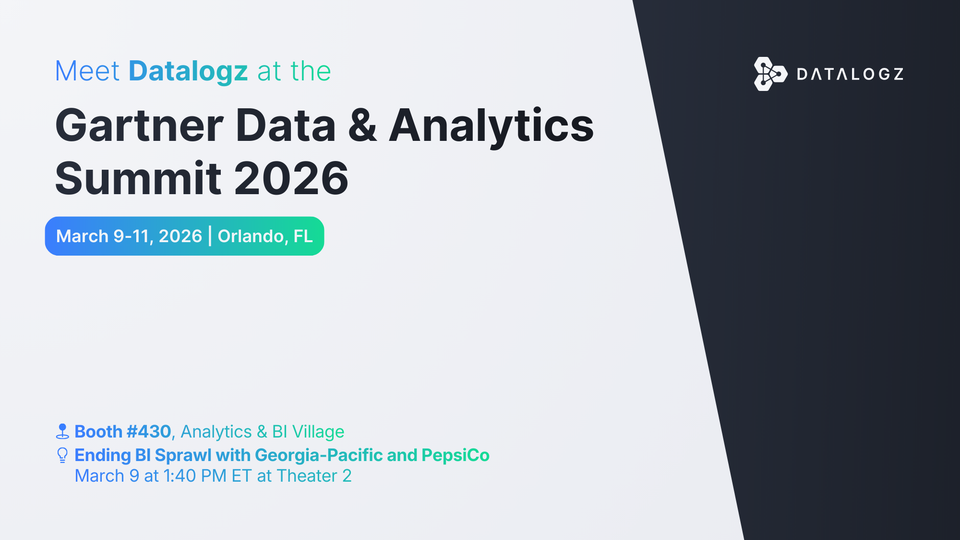
If you're heading to the Gartner Data & Analytics Summit, don't miss our theater session on March 9th at 1:40 PM ET in Theater 2!

If you're heading to the Gartner Data & Analytics Summit, don't miss our theater session on March 9th at 1:40 PM ET in Theater 2!
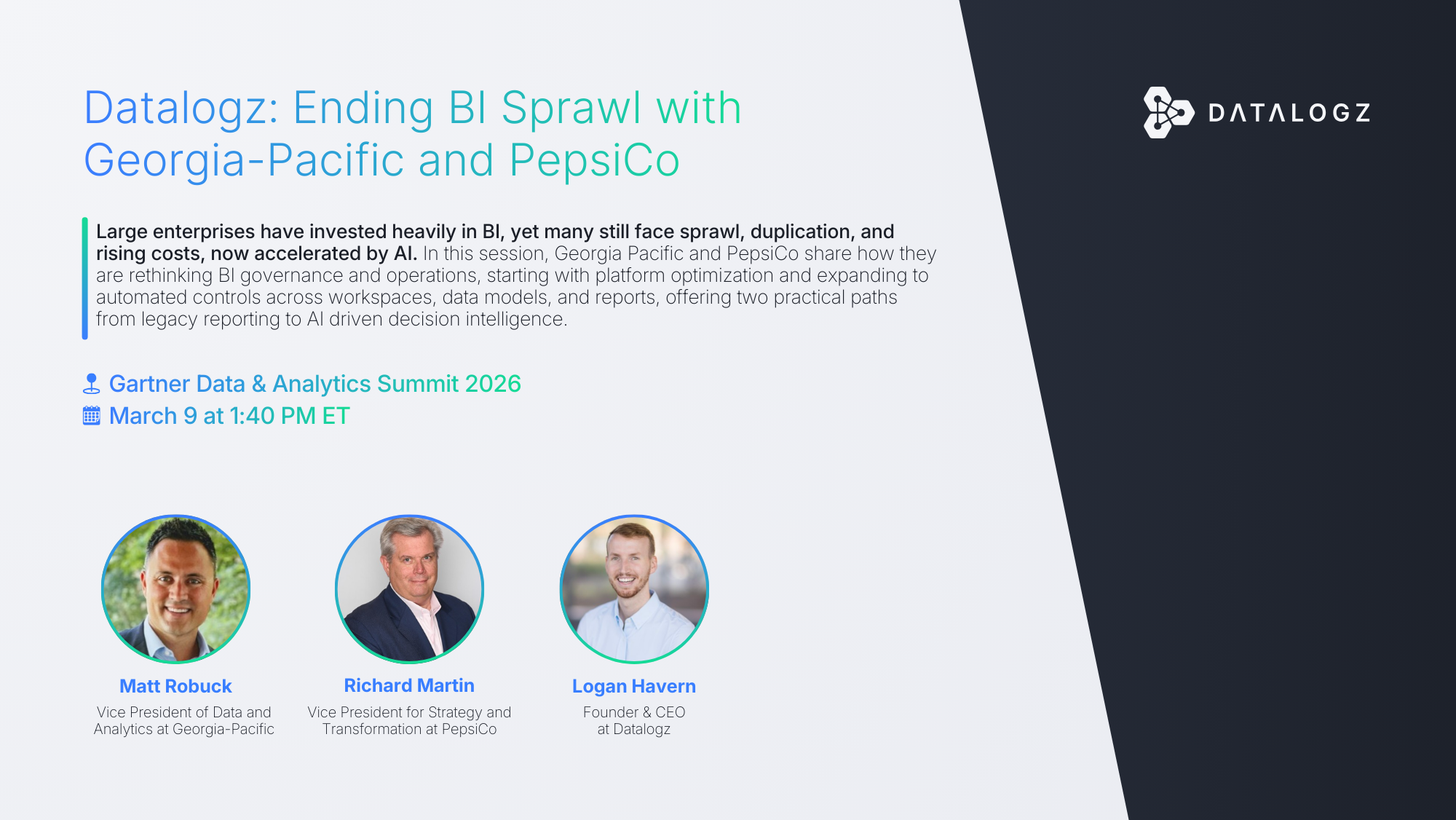
Join Matt Robuck, VP of Data and Analytics at Georgia-Pacific, and Richard Martin, Senior Director for Strategy and Transformation at PepsiCo, alongside Logan Havern, Founder & CEO of Datalogz, as they tackle one of enterprise BI's biggest challenges: sprawl.
Large enterprises have invested heavily in BI, yet many still face duplication, rising costs, and complexity now accelerated by AI. This session offers two practical paths forward, exploring how both companies are rethinking BI governance and operations, from platform optimization and workspace management to automated controls across data models and report lifecycle management.
📊 Why Analytics Still Doesn’t Drive Decisions and How That’s Changing
In a recent Datalogz webinar, CEO Logan Havern and Director of Product Anouk Gorris argued that most enterprises are not ready for decision intelligence because their BI foundations are not ready.
Our customer data shows a 77% year-over-year increase in reports and dashboards from 2025 to 2026, and AI is accelerating that sprawl, not solving it. When people cannot find, trust, or verify existing assets, building something new is always faster than reusing what exists.
This is where BI Ops becomes critical. As Anouk put it during the session: you cannot automate trust, you have to engineer it. Decision intelligence is a trust problem before it is an AI problem, and the teams that get there first will treat BI Ops as a core discipline, not cleanup work.
Datalogz Team on the Road!

Conference season is officially on. For the Datalogz team, it remains one of the fastest ways to stay close to what is changing in data and AI, especially governance, cost, platforms, and outcomes.
Where to find us in March:
📍 Gartner Data & Analytics Summit, Orlando (March 9–11, 2026)
📍 FabCon, Microsoft Fabric Community Conference, Atlanta (March 16–20, 2026)
Attending either event? Connect with the team for a coffee, a quick hello, or a focused discussion on BI Ops, Fabric, governance, and cost optimization.
Frequently Asked Questions
Common questions about this topic, answered.
Why is BI sprawl getting worse even with AI tools available?
BI sprawl is actually accelerating because of AI, not being solved by it. According to Datalogz customer data, there was a 77% year-over-year increase in reports and dashboards from 2025 to 2026. When users cannot find, trust, or verify existing assets, building something new is always faster than reusing what exists—AI just makes creation faster without solving the discovery and trust problem.
What is BI Ops and why does it matter for decision intelligence?
BI Ops is the discipline of managing BI environments operationally—handling governance, lifecycle management, and quality control across dashboards and reports. As Datalogz's Director of Product Anouk Gorris put it: 'You cannot automate trust, you have to engineer it.' Decision intelligence is fundamentally a trust problem before it's an AI problem, and teams that treat BI Ops as a core discipline rather than cleanup work will be best positioned to leverage AI effectively.
How are large enterprises like Georgia-Pacific and PepsiCo addressing BI sprawl?
Both companies are rethinking BI governance through platform optimization, workspace management, and automated controls across data models and report lifecycle management. Georgia-Pacific's VP of Data and Analytics Matt Robuck and PepsiCo's Senior Director Richard Martin have shared approaches that focus on operational discipline rather than just tool consolidation—treating BI sprawl as a governance and process challenge.
What causes enterprises to have duplicate and unused BI content?
Duplication happens when users can't easily find or trust existing assets, making it faster to create new reports than search for existing ones. Large enterprises with heavy BI investments face rising costs and complexity because there's no systematic way to track asset usage, identify redundancy, or manage report lifecycles. Datalogz has identified over 1.4 million optimization issues across customer environments, with governance alerts alone accounting for more than 676,000 instances.
What should data teams fix before implementing decision intelligence or AI analytics?
Teams need to stabilize their BI foundations first—ensuring assets are discoverable, trustworthy, and verified. This means addressing sprawl, establishing governance controls, and implementing usage tracking so people can confidently reuse existing content. Without this foundation, AI will simply accelerate the creation of more redundant, ungoverned content rather than improving decision-making.